- Solar advice hub
- Solar-technology
- Can you run a heat pump with solar panels?
Can you run a heat pump with solar panels?
You can power a heat pump with solar panels, but you’ll still rely on the grid a bit. Here’s what you need to know.


Why you can trust our content
We know that the solar industry is full of misinformation, but we only use reliable sources, including:
- Our experienced solar experts, installers and system designers
- Our own database of solar & battery system designs
- Authoritative bodies like MCS and the UK government



Calculate savings
What kind of home do you live in?


Calculate savings
What kind of home do you live in?
Solar panels and heat pumps: at a glance
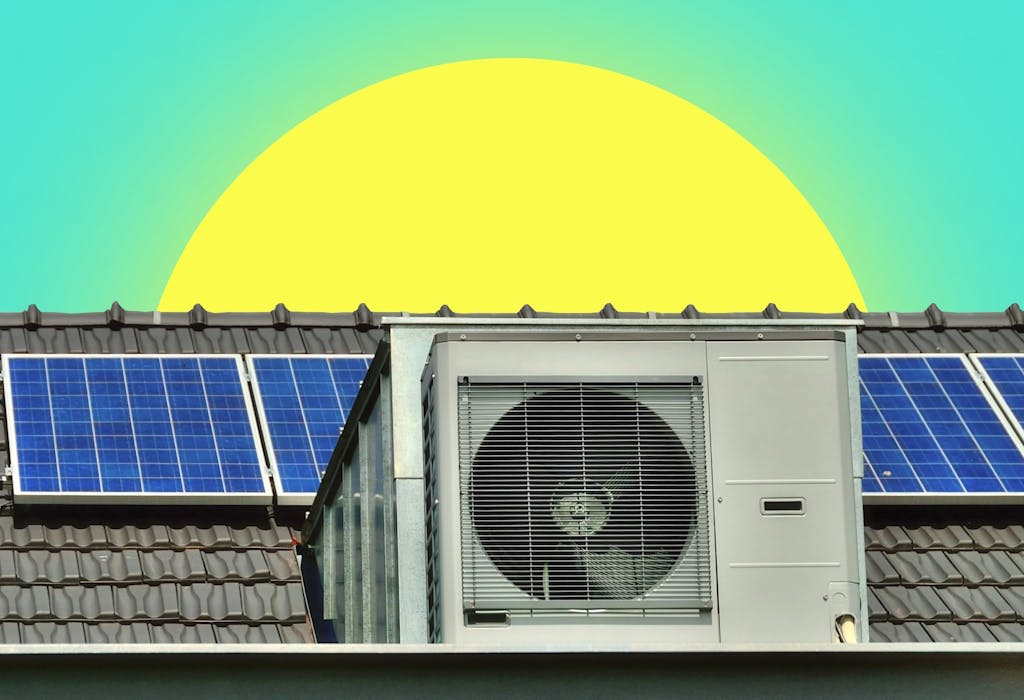
If you like the idea of solar panels, chances are you’ll be thinking of adding a heat pump too – after all, you can run it on the electricity you generate with your panels.
And with Sunsave Plus offering solar panels for no upfront cost and government grants reducing the price of heat pumps, now is an excellent time to make the switch.
In this guide, we’ll explain how using a heat pump with solar panels works, how many panels you’ll need, and which properties are suitable.
If you would like to see the savings you could get from a solar & battery system, answer a few questions below and we’ll provide an estimate.
Find out how much you can save
What kind of home do you live in?
Can you power a heat pump with solar panels?
You can certainly power a heat pump with solar panels; heat pumps are powered by electricity, and solar panels produce electricity all year round.
In fact, it’s one of the best ways to lower your heating bills at the same time as reducing your electricity bills.
You can't expect to cover 100% of your heat pump's electricity needs with solar panels, but your system will still provide a significant chunk.
A heat pump will also slash your bills by increasing your self-consumption – that is, how much of your solar electricity goes towards powering your property, instead of being sent to the grid.
Heat pump sales are growing, with more than 350,000 now installed in the UK – and over half of those installations have taken place since December 2022.
A heat pump will usually increase the average three-bedroom household’s annual electricity usage by around 3,200 kilowatt-hours (kWh) per year.
This figure is based on Ofgem’s Typical Domestic Consumption Values, which put the average UK home's consumption at 11,500kWh of gas per year.
Heat pumps are around 3.5 times more efficient than gas boilers, which means they only require roughly 3,200kWh to achieve the same result.
This will roughly double your total electricity consumption and raise your bills – unless you get solar panels, which can provide you with plenty of free electricity, across the year.
How does it work?
Like a gas boiler, your heat pump will stay on at all times, but will only run – and use substantial amounts of electricity – when it’s needed.
So whenever your property drops below the preferred temperature you’ve set – either according to your thermostat or thermostatic radiator valves – your heat pump will start running.
When this happens during the day, your solar panels will at least partly power your heat pump.
The solar electricity your system produces is sent to power as many electric appliances running in your home as possible. There’s no hierarchy of needs or way of telling which devices receive this green electricity.
So if your solar panels produce 0.7kWh of electricity over an hour, and you use 0.7kWh or less in that hour, your heat pump’s energy consumption will be 100% solar over that time.
If you consume 1kWh in that hour, your entire home’s electricity usage will be 70% solar – including your heat pump.
Adding a battery to your system will enable you to run your heat pump – and other home appliances – with solar electricity more of the time, which will cut your energy bills further (more on this below).
There’s no such thing as a 'solar heat pump' that’s more compatible with solar panels than other models, since all heat pumps work well with solar panels.
This is for the best, since your heat pump will also almost certainly need to use grid electricity at various times.
If you’re wondering how much you could save with a solar & battery system, enter a few details below and we’ll provide an estimate.
Find out how much you can save
What kind of home do you live in?
Can solar panels fully power a heat pump?
It's unlikely that solar panels will fully power your heat pump, unless you get an extraordinarily large system.
This is mostly down to heating needs being highest in winter, when solar panels usually produce less electricity.
The average solar panel system in the UK will likely generate more electricity than your heat pump needs over a year – but it won’t be distributed evenly.
For instance, a 4.9kWp system (which was the average size installed in the UK in 2025) would produce about 3,500kWh per year in Dunsop Bridge, the geographic centre of Britain.
This amount exceeds the 3,200kWh that a typical heat pump needs, but roughly 40% of a solar panel’s output happens in the summer months, according to Sunsave analysis.
This imbalance means your heat pump will still need a helping hand from the grid in the winter months. However, you can sign up to a heat pump tariff with cheaper off-peak periods to keep saving during winter (more on this below).
A real life example
A 2024 study by the Fraunhofer Institute for Solar Energy Systems analysed the impact of a solar & battery system on a home with a heat pump.
It found that the 12.3 kilowatt-peak (kWp) solar panel system and 11.7kWh battery supplied 36.2% of the electricity necessary to run a 13.9kW ground source heat pump for the 256m² house.
This 36.2% figure is also known as the 'solar fraction', which refers to the percentage of total electricity needed for the heat pump that the solar & battery system supplies.
Of the 5,064kWh of electricity the heat pump consumed, 17.8% came directly from the solar panels, and 18.4% was sourced from the battery. The other 63.8% was grid electricity.
Solar vs grid: a heat pump case study
This is an unusually large solar & battery system, supplying electricity to a big heat pump – but since it was all sized up together, the solar fraction should be consistent with a more regular setup.
It should therefore give you a good idea of what to expect if you combine a heat pump with a solar & battery system, though it's still just one example.
Your solar fraction could be much higher, depending on multiple factors.
These include the size of your solar panel system, battery, and heat pump, and whether or not you run your heat pump's hot water heating and disinfection cycle during daylight hours.
How many solar panels do you need to power a heat pump?
How many solar panels you need to power your heat pump alongside your home’s other appliances will ultimately depend on where you live, how much electricity you consume, and when you need it.
A heat pump will increase the amount of electricity your household requires, so you’ll need a larger solar panel system if you want to generate most of the electricity you use – but any size system will help cut your bills.
Property size | Annual electricity usage (kWh) * | Annual electricity usage w/ heat pump (kWh) ** | No. of solar panels required † | Solar panel system size (kWp) | Annual solar output (kWh) †† |
|---|---|---|---|---|---|
1 bedroom | 1,800 | 3,943 | 10 | 4.5 | 3,920 |
2-3 bedrooms | 2,700 | 5,996 | 15 | 6.75 | 5,873 |
4-5 bedrooms | 4,100 | 8,957 | 23 | 10.35 | 9,005 |
A typical home with two or three bedrooms will need a 6.75kWp solar panel system to run a heat pump for most of the year, which you can do by getting 15 solar panels with 450-watt peak ratings.
However, this table is just for households that want to roughly match their electricity usage and solar output.
A smaller system will still cover a healthy chunk of your heat pump’s needs, especially if you also get a storage battery.
This will ensure that even after the sun goes down, you can use solar electricity to heat your home – shrinking your bills further.
Verified expertThe ideal number of solar panels you should get doesn’t really change depending on whether you have a heat pump - either way, it’s best to make full use of the space on your roof. Once you’ve paid the fixed costs of installation such as scaffolding and labour, it makes sense to get as many solar panels as possible.
Alfie Ireland
Head of Operations & Technical at Sunsave
Alfie has worked in green tech for over a decade. During his four years at OVO, he helped develop the world’s largest domestic vehicle-to-grid trial.

Winter vs summer
No realistic domestic setup will be fully sufficient in winter, when solar panels generate less electricity – around 11% of their annual output – right as the thermometer drops and heating usage rises.
As a result, your self-consumption rate should rise. In the study mentioned above, scientists found the household used 94%-100% of its solar electricity in winter, because of this imbalance between supply and demand.
In this situation, with the household's solar fraction plummeting to a high of 26% just as the heat pump requires 63% of its annual usage , the grid will smoothly plug the gap.
During the summer however, your panels are very likely to produce excess electricity, which you can sell to the grid via a solar export tariff.
Due to this overabundance of solar electricity, self-consumption for the home in the study fell below 50% between May and August, hitting a low of 25% in July. The rest can be sold to the grid.
The study also discovered that the heat pump's solar fraction increased above 90% in summer, as the household only relied on it for hot water.
So even though you’ll need to rely on the grid to provide some electricity for your heat pump in winter, you can still save and earn hundreds of pounds per year with a solar & battery system.
Is a solar battery necessary for a heat pump?
A solar battery is the best way to ensure your solar panels supply as much electricity to your heat pump as possible.
The Fraunhofer Institute study we mentioned earlier also included a battery, because that makes it a more effective system.
During winter, spring, and autumn, you can fill up your battery with solar electricity in the daytime, then use this stored energy to heat your household when it gets dark.
In the summer you won’t need your heat pump as much, so after the sun sets, you can sell the electricity in your battery to the grid, through one of the best export tariffs.
As a heat pump will significantly increase your electricity usage, it makes sense to get a slightly bigger battery, to allow you to reduce your bills by using as much solar electricity as possible.
However, it's usually best not to get an oversized battery just so you can squeeze every last drop of solar electricity out of winter, when your heat pump's consumption will be at its highest – or you'll end up with a battery that's too big in summer.
The only possible exception to this rule is if you sign up to a time-of-use tariff like Cosy Octopus, which allows you to charge your battery with cheap off-peak electricity that you can use later to power your heat pump.
You can learn more in our comprehensive guide to the best heat pump tariffs.


How much does a heat pump with solar panels cost?
Technology (for a typical home) * | Size ** | Rough cost † |
|---|---|---|
Heat pump | 6kW | £10,170 |
Solar panels | 6.75kWp | £12,460 |
Battery | 5kWh | £3,000 |
A heat pump with a solar & battery system that can power your home’s electricity and heating for most of the year would usually cost the average household £25,630 – but you can cut this upfront cost dramatically.
The government's Boiler Upgrade Scheme can reduce the cost of an air source heat pump by £7,500, if you live in England or Wales. It'll receive £2.7 billion by 2030, as part of the Warm Homes Plan – so there's plenty to go round.
There are a couple of solar panel grants that cut the upfront cost of solar panels, such as ECO4 and the Warm Homes: Local Grant, but they're aimed at deprived households, and so come with strict eligibility criteria.
However, if you sign up for the UK's first solar subscription, Sunsave Plus, you can switch to solar with no upfront cost, and instead have fixed monthly payments for 20 years.
Every Sunsave Plus system is protected for the full term by the Sunsave Guarantee, which includes 24/7 monitoring, maintenance, a free battery upgrade and replacement inverter if needed, downtime cover, and insurance.
If you’re wondering how much you could save with a solar & battery system, enter a few details below and we’ll provide an estimate.
Find out how much you can save
What kind of home do you live in?
How much does a heat pump cost to run with solar?
Running a heat pump with a solar & battery system will cost the typical three-bedroom household £311 per year on the April 2026 price cap, for a saving of £479.
This is 71% less than the cost of powering a heat pump with grid electricity alone, which is £789 per year for the average home.
We’ve assumed your heat pump will be roughly 350% efficient, and that you’ll consume around 3,200kWh of electricity for heating per year, which follows Ofgem’s averages.
We’ve also assumed that your system will export around one-third of the electricity it produces, and that you’ll split the remaining electricity equally across your heat pump and the rest of your home.
Powering the rest of your household’s appliances with solar energy will save you another £479, on average – and your exports should earn you hundreds of pounds too, depending on which tariff you pick.
How much your household will save also hinges on factors including your location, the size of your solar & battery system, and the amount of electricity and heating your home requires.
Using a heat pump with solar panels slashes your household’s carbon emissions by a total of 2.1 tonnes of CO2 per year, on average.
Is your home suitable for a heat pump and solar panels?
Most homes in the UK are suitable for a heat pump and solar panels.
There may be some steps you can take to maximise the effectiveness of your new systems, but many properties are ready right now.
Heat pump
Heat pumps can be installed in all property types – from flats to detached houses – and in homes from any architectural era, according to the government-funded Electrification of Heat project.
The study's authors wrote: "The suggestion that there are particular home archetypes in Britain that are 'unsuitable' for heat pumps is not supported by project experience and data."
You may need more insulation and to upgrade a few radiators, but as long as you have room outside for the external unit, and space inside to fit a hot water cylinder, that should be it.
And many households won't need to take any measures.
A UK study from 2025 found that "31% of dwellings in the sample could operate with Low Temperature Heat Pumps without upgrades to radiators or fabric, or up to two thirds with High Temperature Heat Pumps".
Solar panels
To get solar panels, you’ll just need to own a suitable roof.
It should be mostly unshaded, face south, east, or west (although north-east and north-west will sometimes be sufficient), and support the weight of panels – which most can.
Most residential flat roofs aren't suitable, as they can't usually handle the extra weight and drilled holes needed to secure the panels.
Dormer roofs are also problematic. They need to be sloped, and even then they tend to be too small to make a solar panel installation worth the expense.
To find out more, read our guide, Is my roof suitable for solar panels?
The best import & export tariffs for a heat pump with solar
Export tariff | Export rate (p/kWh) | Import tariff | Off-peak rate (p/kWh) | Peak rate (p/kWh) | Off-peak window(s) | Total annual savings * |
|---|---|---|---|---|---|---|
British Gas Export Premium | 12 | British Gas Heat Power | 15.99 | 31.98 | 12am-7am 1pm-4pm | £1,537 |
EDF Export 12m | 15 | EDF Heat Pump Tracker | 14.9 | 24.9 | 4am-7am 1pm-4pm | £1,409 |
E.ON Next Flex Export v1 | 6 | E.ON Next Pumped | 21.298 | 39.853 | 6am-4pm 7pm-10pm | £1,217 |
The best import and export tariffs for a solar home with a heat pump are currently provided by British Gas, EDF, and E.ON, all of which could save you hundreds of pounds per year.
If you choose British Gas Heat Power, you can get a generous 10 off-peak hours at 16.8p per kWh.
The peak rate is 33.6p per kWh, but if you shift your consumption and rely on solar electricity, you should be able to almost entirely avoid it.
Households that go with British Gas can benefit from British Gas Export Premium, which pays 12p per kWh if you also get your grid electricity from the supplier.
EDF Heat Pump Tracker is another top-tier option, with a low off-peak rate – even if only lasts for a relatively short six hours.
You'll also be able to sign up for EDF Export 12m, which pays 15p per kWh export rate, making it one of the best choices around.
Alternatively, you could go for E.ON Next Pumped, which provides customers with an astounding 21 off-peak hours – though at higher rates than most.
Its peak rate is also more expensive than the industry average, and E.ON isn't currently allowing people on time-of-use tariffs to sign up for its 13p per kWh export tariff.
This leaves you with its 6p per kWh option, which is substantially less than the other two tariffs.
During off-peak times, you can save money by charging your battery, using your energy-intensive machines (e.g. the washing machine), and running your heat pump's hot water heating and disinfection cycle.
And if you have a battery, you'll be able to store solar electricity to use during peak times.
For the full rundown, check out our article on the best heat pump tariffs.
And to read about every available export rate for solar homes, check out our guide to the best solar export tariffs.
At Sunsave, we’ll consider your individual circumstances before making a recommendation.
Environmental benefits of a heat pump with solar panels
The environmental benefit of using a heat pump with solar panels is that it reduces the average household’s annual carbon emissions by 81%, or 2.1 tonnes of CO2.
This means that such a setup would wipe out the great majority of the typical home’s carbon footprint.
Generally, your heat pump will get about 64% of its electricity from the grid, which still uses gas to generate 27% of its electricity.
This will result in 0.4 tonnes of CO2 emissions – which is a saving of 1.8 tonnes compared to the average gas boiler, according to Nesta.
With a 6.75kWp solar panel system, the average system in the UK will produce an extra 2,679kWh on top of the power needed for your heat pump – which will save an additional 0.3 tonnes of CO2 per year by replacing most of your grid electricity.
Air source vs ground source heat pumps
Both of these technologies can combine well with a solar panel system, though to different levels.
Air source heat pumps use the warmth present in the air as fuel, whereas ground source heat pumps absorb geothermal warmth, using underground pipes.
The complex, disruptive nature of a ground source heat pump installation – which involves either laying 30-50 metres of pipe or drilling boreholes in your garden – makes it the more expensive option.
But in terms of how solar panel systems power them, the two types of heat pumps are identical. As well as natural warmth, they require electricity to function, which solar panels supply.
Ground source heat pumps are usually more efficient across the year, since it's warmer below ground than above it, on average.
They also tend to be more powerful, though this has more to do with the households that have the space and money to get one, rather than being an inherent trait.
This all means ground source heat pumps will make slightly better use of the solar electricity you provide them with, and will generally need more of it.
It's always true that you'll save and earn more with a larger solar panel system, but this fact is especially crucial when you're boosting your electricity usage with a ground source heat pump.
Next steps
Solar panels are an excellent accompaniment to a heat pump, even if you’ll still need to rely on the grid for some of your electricity.
This setup can cut your energy bills by hundreds of pounds per year, and allow you to use an innovative time-of-use import tariff designed for heat pumps, which can be combined with solar export tariffs to maximise your returns.
With government grants like the Boiler Upgrade Scheme making heat pumps affordable and Sunsave Plus providing a solar & battery system at no upfront cost, this is a great time to jump on board.
If you would like to see the savings you could get from a solar & battery system, answer a few questions below and we’ll provide an estimate.
Find out how much you can save
What kind of home do you live in?
Heat pumps with solar panels: FAQs



Related articles
 Josh Jackman
 Josh Jackman
 Josh Jackman
 Josh Jackman
Written byJosh Jackman
Josh has written about the rapid rise of home solar for the past seven years. His data-driven work has been featured in United Nations and World Health Organisation documents, as well as publications including The Eco Experts, Financial Times, The Independent, The Telegraph, The Times, and The Sun. Josh has also been interviewed as a renewables expert on BBC One’s Rip-Off Britain, ITV1’s Tonight show, and BBC Radio 4 and 5.